

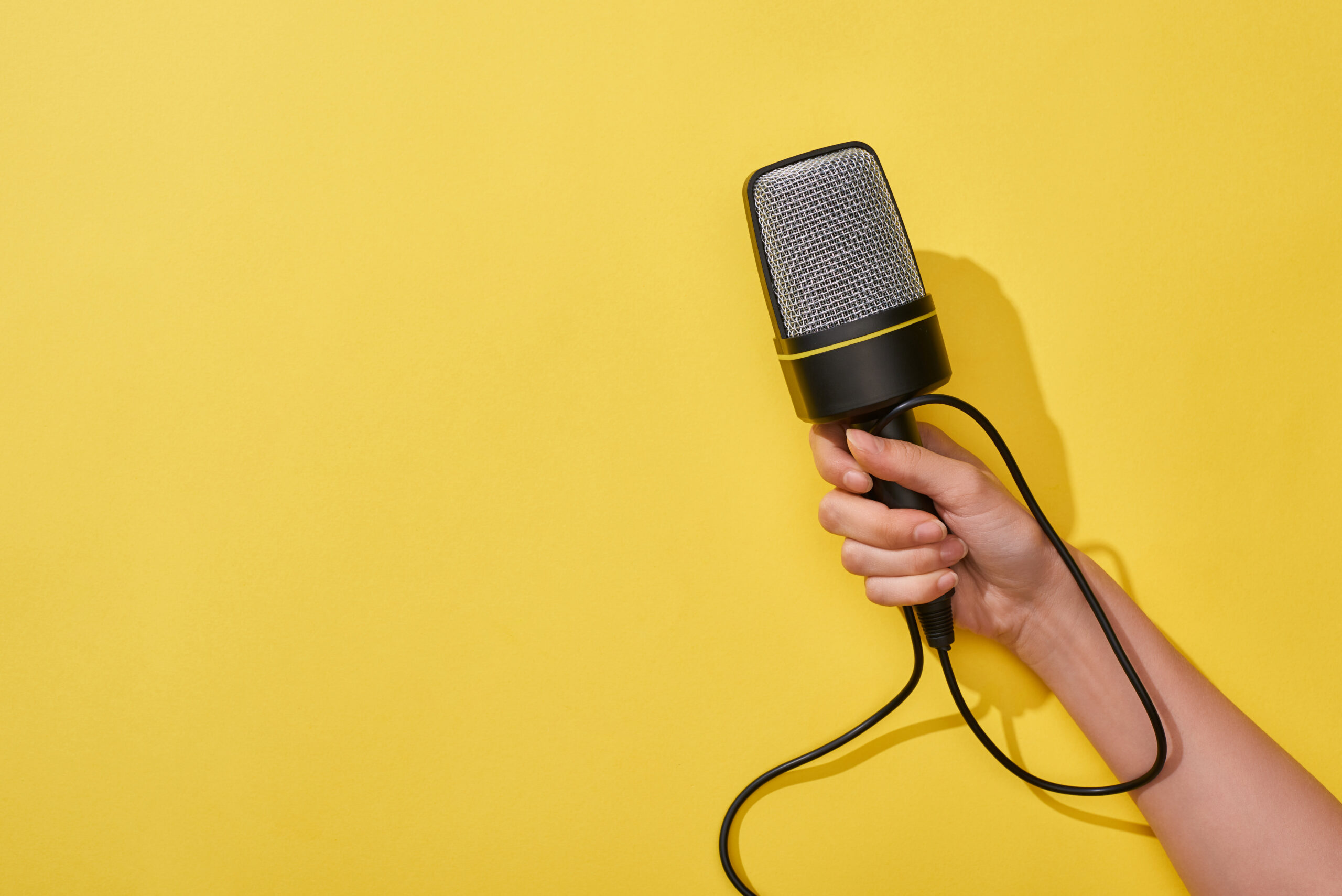


In this special guest blog, GLOW ally and vocal coach Jessica Doyle-Mekkes shares 5 expert tips that will help girls, allies, and advocates speak with confidence and share your message with clarity and purpose.
If you’re reading this blog, I’m guessing there’s something about your voice that you’re not happy with. Whether this unhappiness is part of your current reality or the result of something or someone in your past, it’s time for her to pack her bags and move on. You have things to do, people to see, and lives to change — including your own.
If you already have an idea of what your vocal challenges are, great. Maybe you’ve received feedback that you speak too quickly, too quietly, or without confidence. If so, you’re totally in the right place.
If you aren’t sure of the specifics or are brand-new to using your voice beyond day-to-day conversations, great — you’re also totally in the right place.
If you’re a pretty confident speaker and just want a tune-up before an upcoming event…you guessed it. This is the place for that too.

Jessica Doyle-Mekkes is a vocal coach with 15+ years of experience teaching actors and other notable figures how to speak with confidence.
In my 15+ years as a vocal coach, I’ve worked with pop stars, actors, Fortune 500 execs, and hundreds of women and girls. I am frequently a featured expert on speaking up and making yourself heard.
I know how to help women and girls find their voices and use them fearlessly. I wrote a whole book on it. A book I dedicated to my daughters saying, “May you always know the power of your voice and never be afraid to use it.”
Except, what if they are?
In their book, The Confidence Code for Girls, authors Katty Kay, Claire Shipman, and JillEllyn Riley worked with polling firm Ypulse to survey 1300+ girls ages 8-18 and their parents. What they found was alarming: from ages 8-18, girls’ confidence drops by 30%.
Author and gender researcher Lynn Mikel Brown agrees, stating that in her research, she has seen a “big increase in ‘I don’t know’ responses in early adolescence from girls who were pretty open and outspoken just a year earlier.”
As a university professor, a mom, and a woman, I see this every single day in my students, my daughters, and even in myself. Would my life have been different if I had learned to speak up sooner? I don’t know. What I do know is that taking risks builds confidence, and speaking up, both personally and publicly, is taking a really big risk.
But speaking up is also a skill, one that can be improved. It can be honed, practiced, and prepared for.
What I know is that two of the best ways to build self-efficacy — the belief in your own abilities, — are to have mastery experiences and to engage in verbal persuasion.
Mastery experiences are wins: Taking on a challenge and succeeding.
Verbal persuasion is exactly what it sounds like: Being your own hype-girl.
What I know is that I don’t want my daughter or your daughter or any girl to not know the power of her voice and be able to use it fearlessly. I want to arm every girl with the tools to ask for what she wants and get what she needs — with confidence.
“What I know is that I don’t want my daughter or your daughter or any girl to not know the power of her voice and be able to use it fearlessly.”
So let’s start here.
Below are my proven, actionable tips for how you can start speaking up with confidence, today.
First, you need to see and hear what your audience is seeing and hearing. So grab your cell phone and record a video (yes, camera on). I’m including a practice script below, or you can practice speaking about an issue you care about, like education inequality or child marriage.
The goal is to re-create how you normally speak. Don’t over think it. This is just to find your starting point.
Practice Script:
From “The Secret Garden,” by Frances Hodgson Burnett
I don’t know its name, so I call it Magic. I have never seen the sun rise but Mary and Dickson have and from what they tell me I am sure that it is Magic too. Something pushes it up and draws it. Sometimes since I’ve been in the garden I’ve looked up through the trees at the sky and I have had the strange feeling of being happy as if something were pushing and drawing my chest and making me breathe fast. Magic is always pushing and drawing and making things out of nothing. Everything is made out of Magic, leaves and trees, flowers and birds, badgers and foxes and squirrels and people.
Watch the video and ask yourself:
- Is my voice stable or does it waver?
- Am I too loud? Too quiet?
- Is my voice breathy? Or clear?
- Is the pitch of my voice too high? Too low?
- Do I speak with energy and enthusiasm, or authority (if that’s your goal)?
- Do my words sound lackluster and timid?
- Would you hire, invest, promote, or say ‘yes’ to you?
Once you have an idea of where you’re starting from, use the rest of this blog to meet (and greet) those challenges head on.

Global Catalyst mentors girls around the world to become powerful advocates and confident leaders, including lessons on how to lead with courage and use their voices for impact.
I’ve included my favorite tips, tricks, and exercises created over a 15+ year career of working with thousands of voices to help you create a voice that is strong, healthy, and authentically yours. Let’s go.
5 Ways To Improve Your Communication Skills and Speak With Confidence
-
Volume: Your Voice Deserves to be Heard
Global Catalyst works to amplify girls’ voices — because decisions about girls should be made by girls. So, let’s talk about what to do when your voice needs to be amplified — literally.
If you’re going to be speaking on a microphone, know that the data compression algorithm used in directional mics (the kind in classrooms, court rooms, boardrooms..) is literally designed to amplify low (male) sounds and distort high (female) sounds. It’s the same algorithm used in Bluetooth speakers, on YouTube, and on social media. Yes, that’s true. No, it hasn’t changed since radio was invented in the 1920’s. Yes, it makes me angry too.
So, if you’re going to be speaking into a mic, you must advocate for yourself.
Directional mics only pick up what’s directly in front of them: The closer your mouth can be, the fuller your sound will be. So if you need a stool, ask for one. If you’re going to be walking and talking or using a handheld mic, be sure to practice! Grab a spoon, kitchen-karaoke style, and practice keeping it near your mouth while you speak.
If you’re going to be speaking without a mic and being heard is a concern, try this: Speak louder (really). When a client listens back to her voice recording and complains about not being loud enough, my first question is, “Can you speak louder?”
It may seem silly, but if you’re used to speaking softly or you aren’t aware of how softly you’ve been speaking, sometimes all you need is permission to be louder. To be clear, you don’t need anyone’s permission to speak up, but sometimes you may need a reminder.
-
Dealing with Speaking Anxiety
Girls around the world have advocated against period poverty and stigma, gender stereotypes, and child marriage. These are incredible achievements! They’re also a really big deal and may come with some really big nerves.
When you speak up about something that matters to you, your body’s sympathetic nervous system — your fight-or-flight response — is going to respond: sweaty palms, shaky legs, dry mouth. Here’s the secret: the only difference between ‘nervous’ and ‘excited’ is preparation.
When you know exactly what you want to say, have practiced saying it out loud (for at least two weeks before the event), and have even practiced it in front of other people — get excited. Because you’re prepared.
Here are a few other tips to deal with speaking anxiety:
- Eat protein. Serotonin and dopamine (the body’s ‘feel good’ chemicals) feed on protein. So, before your talk, be sure to feed them!
- Sleep. If you’re not yet 20 years old, you need 8-10 hours of sleep each night. Even one night of poor sleep results in increased anxiety, poor decision-making, and a weakened immune system. Get your ZzZz’s.
- Exercise. Aerobic exercise is like Miracle Gro for your brain. If you want to learn your talk (or anything else) faster and recall it more completely, be sure to move your body for at least 30 minutes each day.
- Deep Breathing. The nerve endings that activate your parasympathetic nervous system — or your rest-and-digest system — are at the bottom of your lungs. So to stay calm, you need to breathe deeply. Tip: It takes an hour to go from stressed to calm, so if you have a talk that’s making you nervous, be sure to focus on your breathing at least an hour beforehand.
-
Pace Yourself
Another way to up the confidence factor when speaking is to pay attention to your pace. According to a study out of the University of Michigan, the key to getting, and keeping, your speaker’s attention is speaking at a moderate pace (about 3.5 words per second) rather than too quickly or too slowly.
This is something I struggle with. When I get excited, my pitch goes up and my words go faster. If this is you too, watch your self-evaluation video again and evaluate your pace. If you’re speeding through the words or speaking so slowly that you’ve stopped listening and started bird watching, adjust accordingly.
-
The Power of the Pause
It’s OK to pause. Pauses are a natural part of conversation. They are also the ultimate power move when speaking. Want to emphasize a point? Pause before it. Making your audience wait for what you will say next is so powerful. Want your answer to a question to be meaningful? Pause, and make your audience wait for what you’re going to say.
Pauses are also a great way to collect your thoughts before speaking and to avoid using filler words such as, “like,” “um,” or, “you know.”
A great place to pause when speaking is wherever there would be punctuation if you were writing. Try not to pause in the middle of a word, a thought, or so many times your audience becomes confused about the content of your conversation.
-
I Just Really Feel Like You Should Stop Apologizing (Does that Make Sense)?
Starting a sentence with “I feel like” is taking your argument, no matter how well thought out, and turning it into a hunch.
You don’t feel like sexual and reproductive health matter: You know that your body belongs only to you and your voice matters.
You don’t feel like it’s important to speak up: You know every time you speak up and every time you educate someone else that you are making your community safer and stronger.
It’s time to stop apologizing when you haven’t done anything wrong. I see this with young women all the time. A student gets up to present and starts by saying, “I’m sorry, this might not be very good.” She thinks her apology is a safety net in case she fails. Instead, it’s setting the expectation that she will.
Constant apologizing does not make you seem polite or kind. It makes you seem less confident, insecure, doubtful, and incompetent. It minimizes you and your accomplishments. And trust me, the one thing you don’t need to be is smaller.
Does that make sense? Yes, you make sense. Unless your audience has the brainpower of a pet rock or you are speaking Elvish, you are making sense. If you don’t, someone will ask you to clarify.
I hope you find as much meaning in reading this blog as I found in writing it. I’m thrilled to be able to use my work to help every girl find her voice and use it fearlessly.
Want more tips on how to speak with confidence? Check out our list of 10 Confidence-Building Questions to Spark Reflection and Growth for Girls.
About The Author
Jessica Doyle-Mekkes has spent the last 15 years studying the human voice and working as a vocal coach for actors, singers, and public speakers. An internationally published writer and sought-after clinician, her bestselling book I’m Speaking: Every Woman’s Guide to Finding Your Voice & Using It Fearlessly (Bloomsbury) was hailed, “a bible in standing your ground without trepidation.” Jessica works as a speaker, advisor, and clinician to individuals, groups, NGO’s, and businesses small and large teaching women how to harness the power of their voices: in their heads & out of their mouths. In 2023, The Coach Foundation identified Jessica as one of the premier Vocal Coaches in the industry. Jessica is the Head of Musical Theatre at East Carolina University where she has taught voice and vocal pedagogy since 2017.
About Global Catalyst
Global Catalyst mentors girls around the world to become powerful advocates and confident leaders. Our signature program, GLOW Club, connects girls in some of the world’s most underserved areas with trusted local mentors and a safe space to express themselves as they develop their agency, find their voice, and build their power. Since our founding, we’ve ignited the power of more than 100,000 girls, sparking a growing movement of youth-led change that is transforming communities — and the world — for the better.